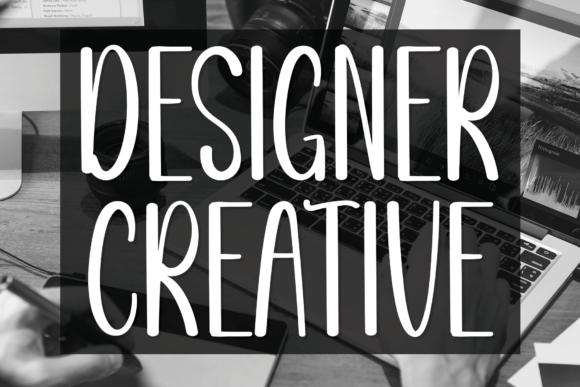
Designer Creative: A Font for Polished Branding
As a small business owner, I’ve learned that the details matter. Whether it’s the way a product label looks on a shelf or how a menu reads at a café, every visual element contributes to the brand experience. Recently, I found myself updating labels for a handmade soap line and realized how much of an impact typography could have. That’s when I discovered Designer Creative, a font that feels both elegant and approachable—perfect for businesses looking to elevate their brand presence without overcomplicating things.
Designer Creative belongs to the script amp category, which blends the fluidity of script with the structure of more traditional typefaces. It has a soft, artistic feel that still maintains clarity, making it ideal for logos, packaging, and social media graphics. The font’s personality is warm and inviting, with subtle flourishes that add character without overwhelming the eye. It’s the kind of typeface that can make a simple phrase feel like a statement.
One of the first places I tested Designer Creative was on a bakery’s packaging. The original labels were plain and generic, blending into the crowd. By switching to Designer Creative, the bakery’s brand identity became more distinct. The font added a touch of sophistication that matched the quality of their pastries. It worked well for the product names, especially when paired with a clean sans serif for the ingredient lists. The result was a package that felt both professional and personal—a balance that’s hard to achieve with most fonts.
Another practical use came when I helped a local candle shop redesign their jar labels. The previous design was too busy, with too many fonts competing for attention. Designer Creative offered a solution that was simple yet effective. Its flowing lines complemented the natural, artisanal vibe of the candles, while its readability ensured that customers could easily read the scent names and ingredients. Even on small labels, the font remained legible, which is a big plus for any business that relies on printed materials.
When it comes to digital branding, Designer Creative shines in social media graphics and website banners. It’s perfect for headlines, promotional text, and creative accents. For example, a beauty brand used it for their Instagram posts, pairing it with a modern sans serif for captions. The contrast created a visually appealing hierarchy that drew attention without being distracting. It also worked well as a watermark on product images, adding a subtle layer of branding that didn’t interfere with the visuals.
One thing I appreciate about Designer Creative is how versatile it is. It works well for both short phrases and longer text, though it’s best suited for display purposes rather than body copy. For instance, it’s great for logos, product titles, and signage, but not ideal for long paragraphs. That said, with proper spacing and font pairing, it can still be used effectively in editorial designs, such as menus or flyers.
For businesses looking to build a consistent brand identity, Designer Creative offers a cohesive look across multiple touchpoints. A boutique used it for tags, stickers, and even thank-you cards, creating a unified aesthetic that customers recognized instantly. It also helped them stand out in a crowded market, where visual consistency is key to building trust and loyalty.
When choosing a font like Designer Creative, it’s important to consider the context. Is it for a logo? A product label? A website header? Each use case may require different weights or styles. Fortunately, Designer Creative includes a range of alternates and ligatures that allow for customization without sacrificing readability. It also supports multiple languages, which is a bonus for businesses targeting international audiences.
Font pairing is another consideration. While Designer Creative can stand alone as a bold, decorative element, it often benefits from being paired with a complementary typeface. A clean sans serif, like Helvetica or Montserrat, can provide balance and contrast, making the overall design feel more polished. Similarly, an elegant serif font, such as Georgia or Cinzel, can add a touch of refinement without clashing.
Before using Designer Creative on any project, I recommend checking the file formats and licensing terms. It should be available in common formats like OTF and TTF, and the commercial license should cover use on products, packaging, and digital assets. This ensures that the font can be used freely across different platforms and materials without legal issues.
Overall, Designer Creative is a valuable addition to any designer’s toolkit. It brings a level of creativity and professionalism that can elevate a brand’s visual presence. Whether you’re a small business owner, a content creator, or a marketer, this font offers a way to express your brand’s personality while maintaining clarity and consistency.